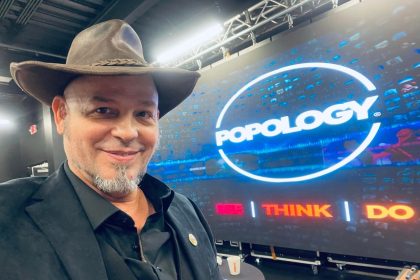

Joe Rey’s professional life has unfolded alongside major changes in the media industry. Over more than three decades, he has worked across film, television, music videos, and advertising, building a career that began in physical production and later expanded into questions of audience measurement, digital visibility, and media infrastructure. He is the founder of POPOLOGY, a project focused on the analysis and verification of engagement across digital platforms.
Raised in Camden, New Jersey, Rey came of age in a setting where music was a constant presence and visual culture shaped everyday life. After High School he attended the Art Institute of Philadelphia, and at 19 entered the production world as an intern for Garrett Brown, the Academy Award-winning inventor of the Steadicam. The experience placed him near a major innovator in modern filmmaking and introduced him to the technical and collaborative demands of professional production.
His early career developed within the Philadelphia production scene, where he worked in Theatre & on local film shoots, commercials, and independent projects. In those years, Rey took on practical roles in art direction, set building, and props, learning the material side of visual storytelling from the ground up. One of his earliest screen credits was as property master on the 1992 independent comedy I Don’t Buy Kisses Anymore, starring Jason Alexander.
As the 1990s progressed, Rey became increasingly involved in music video production, a field that at the time occupied a central place in popular culture and visual experimentation. According to the career history provided, he contributed production design work to projects associated with many top artists including Boyz II Men, TLC, The Offspring, Mary J. Blige, Whitney Houston, Bobby Brown, and Busta Rhymes. He is also described as having worked on productions connected to directors such as Hype Williams, Antoine Fuqua, Marcus Nispel, Joseph Kahn, and Bob Giraldi, all of whom were influential figures in the music video and commercial worlds during that era.
His Los Angeles work reportedly included production design for the Spice Girls’ “Spice Up Your Life” and “Victory” by Puff Daddy featuring The Notorious B.I.G. and Busta Rhymes. He is also described as having co-directed, with Marcus Nispel, Bryan Adams’ “Cloud Number Nine” in 1999. The same account credits Rey with co-directing and production designing the Backstreet Boys’ “Larger Than Life” with Joseph Kahn, and later directing LeAnn Rimes’ “I Need You” after joining Kahn’s Super Mega production company.
These projects came during a transitional period in the industry, when high-budget music videos were still often produced on large film formats even as digital production tools were becoming more widely adopted. Rey’s work during that time placed him in a part of the business where visual scale, technical precision, and fast-moving collaboration were all essential.
He later expanded into commercial directing, bringing a production designer’s attention to image construction into agency and brand work. According to the account provided, he worked with Ridley Scott’s RSAUSA production company and later directed in New York under Bob Giraldi. His commercial work included assignments with agencies such as McCann Erickson, FCB, and BBDO, as well as brand-related campaigns involving Chrysler, AT&T, Dr Pepper, Sony, Lowe’s Home Improvement, and Future Shop. He is also described as having directed second-unit work for Giraldi on Ricky Martin’s “Loaded.”
Taken together, this phase of Rey’s career reflects a broader movement from specialized production roles into creative leadership. It also placed him within a changing media economy, where the visual grammar of television advertising, music videos, and branded entertainment increasingly overlapped.
Over time, Rey’s interests appear to have shifted beyond the making of media toward the systems that govern how media circulates and how attention is measured. Having worked through the late analog era and into the digital transition, he witnessed an industry move away from traditional gatekeepers such as studios, record labels, and broadcast networks toward a more fragmented environment shaped by platforms, streaming systems, and algorithmic distribution.
That shift forms part of the context for his later work. Rather than focusing only on the production of images, Rey became increasingly interested in the structures behind visibility itself: how audiences are counted, how popularity is determined, and whether existing systems of measurement accurately reflect public attention.
Those questions would later inform POPOLOGY, the media and data infrastructure project he founded. According to the account provided, Rey first began sketching out the concept in August 2001, shortly before the September 11 attacks. What began as an idea tied to storytelling and audience connection later developed into a broader effort centered on tracking and verifying engagement across digital platforms.
In that sense, POPOLOGY represents a continuation of Rey’s earlier work by different means. If his production career was grounded in constructing images and experiences, his later work asks how those experiences are recorded, valued, and understood once they enter the digital ecosystem. The emphasis shifts from making content to examining the systems that define its reach and meaning.
What gives Rey’s career its coherence is that both phases are rooted in the mechanics of media. His early years were shaped by the practical realities of sets, crews, budgets, timing, and visual design. His later work turns to analytics, infrastructure, and accountability. In each case, the central concern remains the same: how media is built, how it moves through culture, and how its impact is recognized.
From Philadelphia production sets to music video soundstages, from commercial campaigns to digital media analysis, Joe Rey’s professional path reflects the broader evolution of the media industries over the last three decades. His career traces a passage from the craft of image-making to the study of the systems that determine how those images are seen.