
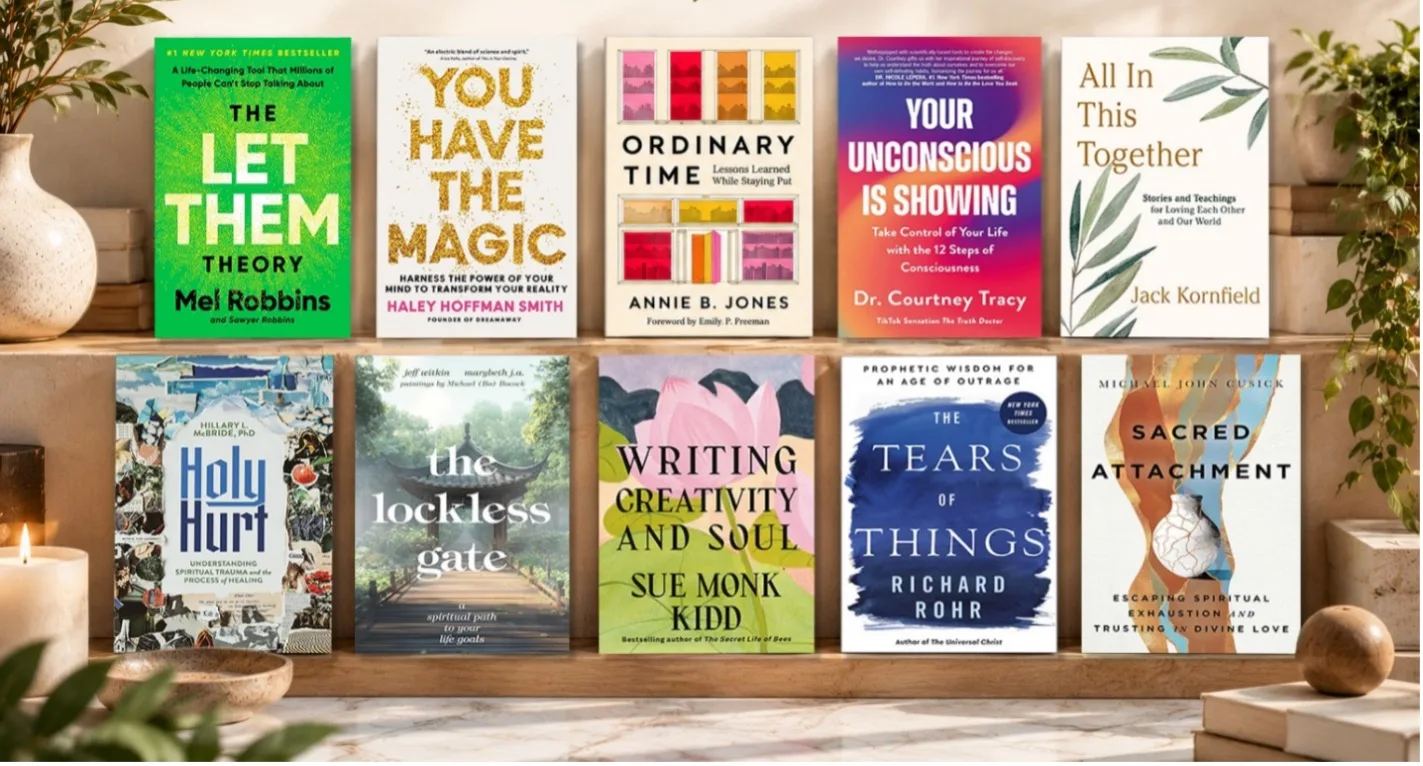
If this year taught me anything, it’s that a fuller life doesn’t begin with changing everything. It begins with changing how you look at yourself, at the people in your life, and at the days you’re already living. These ten books came at that shift from different directions: letting go of control, healing old wounds, trusting your own creativity, and finding purpose in ordinary moments. Some speak the language of psychology, some draw on contemplative tradition, and some sound like a friend across the table. What they share is the conviction that change starts on the inside and works its way out into how we love, work, and live.
The Let Them Theory by Mel Robbins
I had to start here, because the idea is built on just two words. Robbins argues that when we feel stuck or frustrated, we’ve often handed our power to other people and their opinions, drama, and judgments. Let them be who they are, and you can stop managing everyone and put that energy into your own goals. Her style is direct and research-informed, with stories from her own life, and she applies the idea across eight areas, from work to habits to fresh starts.
You Have the Magic by Haley Hoffman Smith
This is where the turn from managing others to trusting yourself really took hold for me. Smith is a coach, TEDx speaker, and podcast host who works with the subconscious through EFT tapping. Her book is a manual for reshaping your life through the mind, using neuroscience-grounded practices to reprogram old patterns and release emotional blocks.
Ordinary Time by Annie B. Jones
After all that reaching, this book felt like a deep breath. Jones owns an independent bookstore in Thomasville, Georgia, and she writes about the adventurous adulthood she once imagined versus the quieter life she actually built: a small town, a marriage, a bookstore, and a faith she sometimes struggled to recognize. Her essays are funny and hopeful, and they push back on the idea that only loud lives matter. An ordinary life, it turns out, can be bigger than it looks.
Your Unconscious Is Showing by Dr. Courtney Tracy
Tracy, a psychotherapist known as “The Truth Doctor,” starts with a frustration I know well: wanting to improve and never following through. Her point is that the problem isn’t willpower. Feeling out of control is part of being human, and the answer is making peace with the unconscious so it works with you. Organized around twelve steps of consciousness, the book mixes research and candid stories, and it reads like a psychology lesson from a therapist friend.
All in This Together by Jack Kornfield
Here, self-compassion widens into compassion for the world. Kornfield trained as a Buddhist monk in Thailand, Burma, and India, and this collection of stories and teachings speaks to a time of shared anxiety. He draws on the life of the Buddha, Arthurian legend, and voices like Ram Dass and Mary Oliver to help readers remember their basic goodness, loosen fear’s grip, and imagine a world where everyone belongs.
Holy Hurt by Hillary L. McBride
Sometimes the heart needs healing before it can open, and McBride writes with real care about wounds that come from places meant to be holy. A psychologist and researcher, she affirms that spiritual trauma is real and that healing is possible. She weaves together clinical research, trauma literature, expert interviews, and personal stories, and each chapter ends with a practice for beginning to heal. It’s valuable for anyone who has lived through spiritual harm and for anyone hoping to build healthier faith communities.
The Lockless Gate by Jeff Witkin and Marybeth J.A.
Once healing begins, a new question comes up: where do I go from here? This book is written for exactly that crossroads. Witkin is a psychologist and award-winning poet, and Marybeth J.A. shaped her insights through theater, global travel, and time with Indigenous elders and spiritual mystics. Together they offer a field manual for setting goals that bring physical and spiritual well-being together, with clear daily tasks that turn intention into action and a healthy dose of whimsy.
Writing Creativity and Soul by Sue Monk Kidd
Creation starting with a single step is the heart of Kidd’s story. She began writing at thirty and went on to write The Secret Life of Bees, after once watching a teacher list suitable careers for women that didn’t include “writer.” Drawing on her own life and on writers like Virginia Woolf and Maya Angelou, she offers a map for anyone lost on the creative path. It’s part memoir and part philosophy, resting on the belief that writing is a spiritual act that rises from the soul.
The Tears of Things by Richard Rohr
Finding your voice also means deciding what to do with grief and anger, and Rohr takes that up with great tenderness. A Franciscan friar, he calls this his most personal book. He turns to the Hebrew prophets to ask how we can live compassionately amid violence and despair. The prophets often began in rage, but their words matured into lament and finally compassion, an approach he calls sacred criticism.
Sacred Attachment by Michael John Cusick
I saved this one for last. Cusick, a psychotherapist, begins with a question many of us quietly carry: what happens when belief and experience feel too far apart? He speaks to readers who feel lost or exhausted yet still long for a relationship with God, and he applies human attachment theory to that relationship. His suggestion is that struggling to believe isn’t a barrier but a bridge.
Read together, these books circle one idea for me: becoming whole is inner work that never stays inside. The more honestly we tend our inner lives, the more freely we can show up for the people and the world around us.
If you’re at the beginning of that work, be patient. Growth rarely announces itself. It comes in small steps: a boundary kept, a page written, a prayer said. Pick the one book that speaks to where you are right now, and trust that the path you’re building is already taking you somewhere good.