

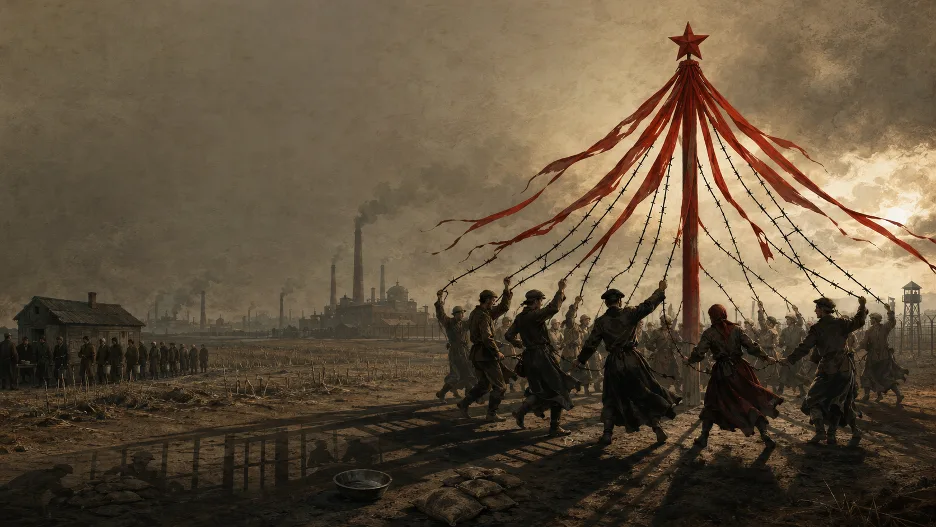
Every May, familiar images return. Red flags rise above crowded streets. Speakers condemn capitalism, private property, the United States, and the inequalities of modern life. The language is often presented as a defense of ordinary workers against wealth, exploitation, and corporate power.
There is nothing illegitimate about examining capitalism critically. Markets can be distorted. Corporations can abuse power. Workers can be mistreated. Wealth can become concentrated, particularly when competition, accountability, and the rule of law are weak.
The intellectual problem begins when capitalism is judged exclusively by its failures, while communism is judged exclusively by its intentions.
That comparison places an imperfect economic system beside an imagined utopia. It allows Marxist writers to describe equality, solidarity, and liberation without confronting what governments committed to Marxist rule actually did after taking power. The prisons, confiscations, famines, executions, forced labor systems, and censorship become inconvenient footnotes.
William Johnson challenges this selective memory in Murderous Marxism, a political history book that examines the repeated gap between communism’s promises and its consequences. The book’s official description identifies the Red Terror, forced famines, propaganda, and the machinery of the communist police state as central parts of that record. Johnson’s argument is not simply that communist governments made mistakes. It is that concentrated political and economic power that repeatedly made large-scale repression possible.
When a Workers’ Celebration Becomes a Political Performance
May Day did not begin as a Soviet holiday. Its political history is connected to the nineteenth-century labor movement, the struggle for an eight-hour workday, and the 1886 Haymarket affair in Chicago. In 1889, the Second International designated May 1 as a day of international worker protest.
Those origins matter. Supporting lawful unions, safer workplaces, reasonable hours, and fair compensation does not make someone a communist. Workers deserve dignity and protection regardless of the economic system under which they live.
Yet communist governments eventually transformed May Day into something very different. In the Soviet Union, it became an enormous state-managed spectacle. Workers marched beneath party symbols while political officials watched from above. Military hardware, ideological banners, and portraits of leaders dominated the celebration.
The contradiction was difficult to miss. The state claimed to represent workers, but workers could not establish genuinely independent unions, remove their leaders through competitive elections, publish criticism of the ruling party, or organize against government policy without risking punishment.
The holiday belonged to labor in name. In practice, it belonged to the party.
Capitalism and the Decline of Extreme Poverty
Marxist criticism often treats poverty as a creation of capitalism. History tells a different story. For most of human existence, severe poverty was the ordinary condition of life. The meaningful question is therefore not whether poverty exists in market economies. It does. The question is which institutions have enabled the greatest number of people to escape it.
The World Bank reports that the number of people living in extreme poverty fell from approximately 2.3 billion in 1990 to about 831 million in 2025. The decline was driven largely by sustained economic growth in East Asia and South Asia.
This progress cannot be credited to completely unregulated markets. Public education, infrastructure, healthcare, legal institutions, targeted assistance, and international development also mattered. Nevertheless, trade, private investment, entrepreneurship, industrial expansion, and participation in global markets were essential drivers.
China offers one of the clearest examples. The country remains under Communist Party rule, but its dramatic economic advancement began after the reforms initiated in 1978. China allowed greater private initiative, opened itself to foreign investment, expanded export manufacturing, and integrated into international markets. The World Bank estimates that this period of reform and opening helped lift nearly 800 million Chinese citizens out of extreme poverty.
The improvement did not come from intensifying Maoist central planning. It followed a retreat from it.
The Technology Marxist Critics Use
There is also an irony in the way modern anti-capitalist arguments are distributed. Critiques of American enterprise now travel through smartphones, commercial websites, privately operated social platforms, cloud networks, and telecommunications systems built through enormous investment and competition.
The internet itself was not created by capitalism alone. Publicly funded American research was fundamental. DARPA’s ARPANET became operational in 1969, and the National Science Foundation later developed NSFNET as a major academic backbone.
Public research provided critical foundations. Competitive markets then helped turn a limited research network into infrastructure used by billions of people. Companies invested in semiconductors, fiber-optic cables, wireless networks, personal computers, smartphones, operating systems, applications, data centers, and consumer services. Competition reduced costs and created uses that the original researchers could not have fully anticipated.
This distinction strengthens the case for an open economic system. Innovation often emerges from cooperation among universities, governments, inventors, and businesses. Markets provide a mechanism for testing ideas, expanding successful products, and replacing unsuccessful ones without requiring a central authority to dictate every outcome.
The Bolshevik Promise
Before seizing power in Russia in 1917, the Bolsheviks promised bread, land, peace, and government through workers’ councils. These promises appealed to a population exhausted by war, shortages, inequality, and political disorder.
Once power had been consolidated, the promises narrowed. The elected Constituent Assembly was dissolved. Rival socialist organizations were suppressed. Independent publications were closed. Political policing expanded, and workers’ councils were subordinated to Communist Party authority.
The revolution had promised to transfer power to workers. Instead, it transferred power to a centralized organization that claimed the exclusive right to speak for them.
This transformation is central to Johnson’s treatment of communism. Public material accompanying Murderous Marxism emphasizes the way liberation language can conceal coercive structures. Johnson’s discussion of Lenin and the Red Terror focuses on secret policing, ideological persecution, executions, propaganda, and the use of fear to suppress opposition.
The relevance of that history is not limited to Lenin’s personality. It demonstrates what becomes possible when a ruling movement controls the government, press, courts, economy, police, and official interpretation of history at the same time.
War Communism and the Confiscation of Survival
From 1918 to 1921, the Bolshevik government imposed policies known collectively as War Communism. Russia was fighting a devastating civil war, and multiple armies seized food and resources. That context must be recognized, but it does not erase the destructive effects of Bolshevik policy.
The state nationalized major industries, restricted private trade, centralized distribution, requisitioned agricultural produce, and imposed severe labor discipline. Inflation weakened the currency until barter became common. Factory committees lost power as economic decision-making moved upward into state institutions.
For peasants, grain requisitioning frequently meant armed detachments taking produce from rural communities. When farmers knew that additional production would be confiscated, their incentive to produce beyond immediate survival diminished. Agricultural output declined, black markets expanded, factories struggled, and people left cities in search of food.
The International Encyclopedia of the First World War records the economic decline, punitive labor rules, worker protests, peasant rebellion, and loss of authority by unions and factory committees during this period.
The state had claimed that abolishing private economic power would liberate workers. Instead, the government became the employer, distributor, rationing authority, police force, and final judge of political loyalty.
When Workers Resisted the Workers’ State
Workers and peasants did not always accept this arrangement quietly. Strikes and demonstrations emerged as food supplies deteriorated and political repression increased. The government responded with restrictions, factory closures, arrests, and military force.
Peasant resistance grew in regions such as Tambov, where communities fought grain confiscation and Bolshevik authority. In March 1921, sailors at the Kronstadt naval base rebelled. Many of them had previously supported the revolution. They demanded freer elections to the soviets, civil liberties, and relief from coercive economic controls.
The government portrayed them as counterrevolutionaries and crushed the uprising. Survivors faced imprisonment, exile, and execution.
The episode revealed a defining contradiction. Workers were celebrated as the heroic foundation of the revolution when they supported the party. When they organized independently, they became enemies of the revolution.
Famine Under Lenin
The Russian famine of 1921 and 1922 had several causes. World War I, revolution, civil war, drought, disease, damaged transportation, and economic collapse all contributed. Historical accuracy requires acknowledging all of them.
It also requires acknowledging grain requisitioning and War Communism.
Years of confiscation had reduced production and shattered trust between rural communities and the government. Stanford’s history of the crisis notes that the famine was exacerbated by mass government requisitioning. Death estimates vary, but five million is among the figures most commonly cited.
The American Relief Administration, led by Herbert Hoover, eventually mounted an enormous humanitarian operation that fed millions. The United States, routinely condemned in communist propaganda as the enemy of workers, helped prevent even greater loss of life.
By 1921, Lenin retreated from the economic program. The New Economic Policy restored limited private trade and allowed small businesses and farmers more freedom. Political control remained firmly with the Communist Party, but market activity was permitted to repair some of the damage created by the attempt to abolish it.
A Pattern Larger Than Russia
The danger identified in Murderous Marxism extends beyond one country or leader. Johnson’s official materials describe recurring patterns across communist systems: propaganda, suppression of dissent, secret policing, forced labor, politically induced hunger, and the rewriting or concealment of history.
Those patterns appeared in different forms under Mao Zedong, the Khmer Rouge, the Kim dynasty in North Korea, and other communist governments. The causes and scale of each tragedy were not identical, but the concentration of unchecked authority was a common feature.
During China’s Great Leap Forward, forced collectivization, inflated production reports, unrealistic targets, and excessive grain procurement contributed to a famine that killed tens of millions. In Cambodia, the United States Holocaust Memorial Museum reports that nearly two million people died under the Khmer Rouge through execution, forced labor, hunger, and disease.
These events cannot be dismissed by claiming that true communism was never attempted. Governments acted in the name of communist ideology, reorganized society according to its principles, and used state power to eliminate the institutions that might have restrained them.
History Must Be Judged by Consequences
Capitalism should be criticized where it fails. Corporate misconduct, inequality, exploitation, financial instability, and environmental damage deserve serious examination. Free societies depend on the ability to investigate power rather than worship it.
But criticism of capitalism cannot require silence about communism.
Corporate corruption does not excuse political prisons. Economic inequality does not justify forced collectivization. Market failures cannot erase mass confiscation, censorship, executions, or famine.
The most durable systems recognize that human beings are fallible and that power must therefore be divided. Competitive markets divide economic authority. Constitutional government divides political authority. Independent courts, elections, property rights, unions, religious liberty, civil society, and a free press add further restraints.
Communist governments removed those restraints in the name of equality. Once political and economic authority had been concentrated, ordinary people had few peaceful ways to challenge the state.
That is why the history explored in William Johnson’s Murderous Marxism remains relevant. Its central warning is not that every demand for reform leads to dictatorship. It is that moral promises should never exempt a political movement from scrutiny. Ideologies must be judged not only by the future they describe but also by the institutions they create, the powers they claim, and the human consequences they produce.
When writers gather around the communist Maypole and condemn capitalism, they are entitled to make their case. They should also be prepared to confront the full historical record: the confiscated farms, silenced workers, suppressed rebellions, prison camps, and mass graves.
History does not become false because it is politically inconvenient.
Further Reading
Murderous Marxism by William Johnson examines communist ideology, totalitarian control, state violence, forced famine, propaganda, and the historical treatment of communist crimes. The book is available on Amazon