
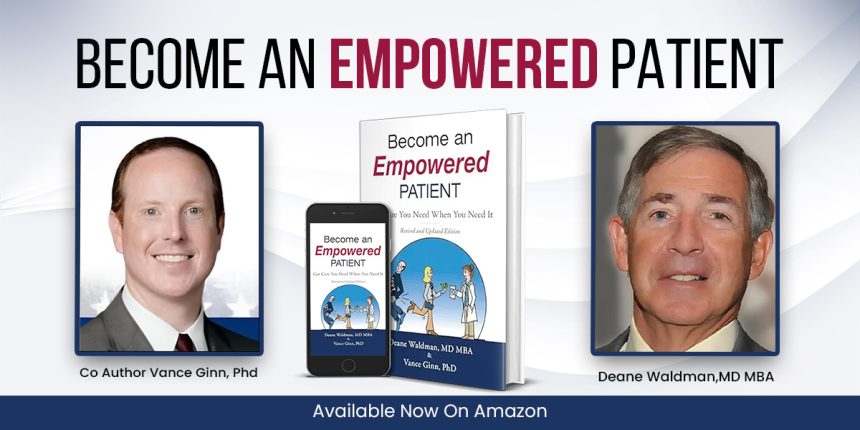
Amidst the vast landscape of modern healthcare literature, there occasionally emerges an author whose work resonates deeply, inviting readers on a compelling journey through the failures and possibilities of American medicine. Deane Waldman, an accomplished pediatric cardiologist turned policy reformer, has masterfully crafted such a work in his latest book, Become an Empowered Patient. Co-authored with economist Dr. Vance Ginn, this urgent and accessible volume blends clinical authority with economic rigor, offering readers a thought-provoking exploration of why Americans cannot get the care they need, and, more importantly, exactly what it would take to fix that.
The Book’s Core Argument
At the heart of Become an Empowered Patient lies a diagnosis most healthcare commentators have been reluctant to make plainly: the American healthcare system is not merely inefficient, it is structurally designed to serve everyone except the patient. Dr. Waldman, who spent nearly four decades as a pediatric cardiologist and served as Chief of Cardiology at three major institutions, including the University of Chicago, argues that every dollar wasted, every appointment delayed, and every physician driven from practice traces back to a single root cause: the wrong people control the money. It is within this uncomfortable truth that the book’s argument takes root, and where its proposed solution begins to take shape.
Author Profile: Dr. Deane Waldman
Before exploring the book further, it is worth understanding the mind behind it. Dr. Deane Waldman is not a think-tank theorist or a career politician. He is a Yale and Chicago Medical School graduate who trained at Mayo Clinic, Northwestern, and Harvard. He holds an MBA alongside his MD, earned in his mid-fifties after years of frustration trying to make the system work for his patients from within. He served as Distinguished Senior Fellow in Healthcare Policy at the Texas Public Policy Foundation, sat on the board of the New Mexico Health Insurance Exchange, and has published more than 350 articles in outlets including the Wall Street Journal, Forbes, and Fox News. His 14 books on healthcare policy were each, in their own way, building toward this one. It is during the daily frustrations of clinical practice, watching insurance companies override his orders, watching capable physicians leave medicine, watching patients wait months for appointments their coverage technically promised, that Dr. Waldman found the seeds of this book’s urgent argument.
A Cardiologist and an Economist Walk Into a Policy Crisis
Become an Empowered Patient introduces readers to a collaboration that is, on its surface, an unlikely one. Dr. Waldman brings the clinical authority: the diagnosis, the patient’s perspective, the firsthand account of a system that punishes the very people it was built to serve. Dr. Vance Ginn, a PhD economist and former Chief Economist for the Office of Management and Budget, brings the financial architecture: the understanding of how money actually flows through the system, where it disappears, and how its course might be redirected. As their partnership developed at the Texas Public Policy Foundation, sparked by a phone call from a Texas CEO who could not understand why his employees could not access the care their premiums were paying for, the two men realized that what healthcare lacked was not more policy, but a fundamental reassignment of financial authority, from institutions to individuals.
The Money Trail and What It Reveals
The book’s most striking analytical contribution is its unflinching examination of where the healthcare dollar actually goes. In one of the volume’s most memorable images, the authors describe a tractor-trailer loaded with money, spilling its contents as government agencies, insurance companies, compliance departments, and hospital administrators each claim their portion before anything reaches the patient or the physician treating them. Last year, the United States spent approximately $5 trillion on healthcare. More than half of that, the authors demonstrate, went to administration, bureaucracy, regulatory compliance, and overhead, not to the doctors, nurses, therapists, and pharmacists who actually provide care. Perhaps the most arresting data point in the book concerns a graph the authors call THE graph: between 1970 and 2020, the number of physicians in the United States grew by 100 percent. The number of healthcare administrators, people who provide no clinical care whatsoever, grew by 4,400 percent. For every one doctor added to the system over those five decades, 44 non-clinical bureaucrats were added alongside them.
Themes Explored in ‘Become an Empowered Patient’
The book masterfully explores themes that resonate with readers from every walk of life. Financial autonomy and patient sovereignty take center stage as Dr. Waldman and Dr. Ginn examine what happens when ordinary Americans are given direct control of their healthcare spending. The authors are equally attentive to the experience of physicians, dedicating substantial attention to what Dr. Waldman calls the psychic reward of medicine: the deep professional satisfaction a doctor feels when a patient recovers through their own clinical effort and judgment. Federal regulations, the authors argue, have systematically eroded that reward, turning what was once a vocation into a compliance exercise. The book also addresses the politically charged landscape of healthcare reform with notable intellectual honesty, including a chapter devoted entirely to the misinformation, from both sides, that has clouded public understanding of how the system actually works. Most strikingly, Become an Empowered Patient acknowledges its own central limitation: no national government has ever fully withdrawn from healthcare management, so there is no proven model to point to. The authors make this admission directly, and then make the case anyway.
A Career and a Cause
Dr. Waldman’s literary output is not simply the product of an author’s imagination, it is the distillation of a career spent fighting the same battle from the inside. As a former Chief of Pediatric Cardiology at three major institutions, a professor of pediatrics, pathology, and decision science, a former director of a state health insurance exchange, and a policy fellow at one of the country’s leading conservative think tanks, he brings a depth of institutional knowledge to Become an Empowered Patient that is difficult to replicate. His prior books, including Single Payer Won’t Save Us and the award-winning Curing the Cancer in U.S. Healthcare, which earned a Bronze Medal in the 2020 Independent Publishers Book Award, each diagnosed a different facet of the same illness. This book, he says, is the first to offer the full cure. His 37 years of clinical practice and more than a decade of healthcare policy work provide the unique perspective that distinguishes his voice in a crowded field.
The Empower Patients Initiative
The solution Dr. Waldman and Dr. Ginn propose is called the Empower Patients Initiative, or EPI. Its central mechanism is a no-limit Health Savings Account into which the roughly $27,000 that currently travels from employers to insurance companies each year, wages the employee earned but never received, a relic of a wartime wage freeze dating to 1942, would instead go directly to the employee. The patient would then use that account to purchase high-deductible catastrophic insurance and pay directly for routine care, restoring the direct financial relationship between buyer and seller that drives quality up and costs down in every other sector of the economy. The authors illustrate this with real-world examples: a routine check-up that costs $26,993 under the current system costs $6,250 under EPI; a spine surgery that cost one patient $126,000 through the VA system cost $11,250 at a direct-pay surgery center in Oklahoma. For Medicaid recipients, state funds would supply the HSA directly, putting the same spending authority in the hands of the most vulnerable patients. As a byproduct, the authors note, Medicaid fraud becomes mathematically impossible: you cannot defraud a system in which the money goes directly to the people it was meant to serve.
A Journey With ‘Become an Empowered Patient’
Become an Empowered Patient is more than a policy book; it is an invitation to reconsider everything you think you know about why American healthcare fails and what it would take to fix it. Dr. Waldman and Dr. Ginn write not for specialists but for the American public, for the patient who waited four months for an appointment their insurance card promised, for the physician who left medicine because the paperwork swallowed the practice, and for the citizen who suspects that the system was never really built for them. The book is available in both English and Spanish, a deliberate choice that reflects the authors’ conviction that healthcare reform must be a conversation that crosses every community. Dr. Waldman’s ask of readers is characteristically direct: talk to your neighbors, read the book together, and begin the grassroots conversation that Washington has failed to start. With Become an Empowered Patient, Deane Waldman ensures that the diagnosis is finally paired with a prescription, and that both are written in language every American can understand.