

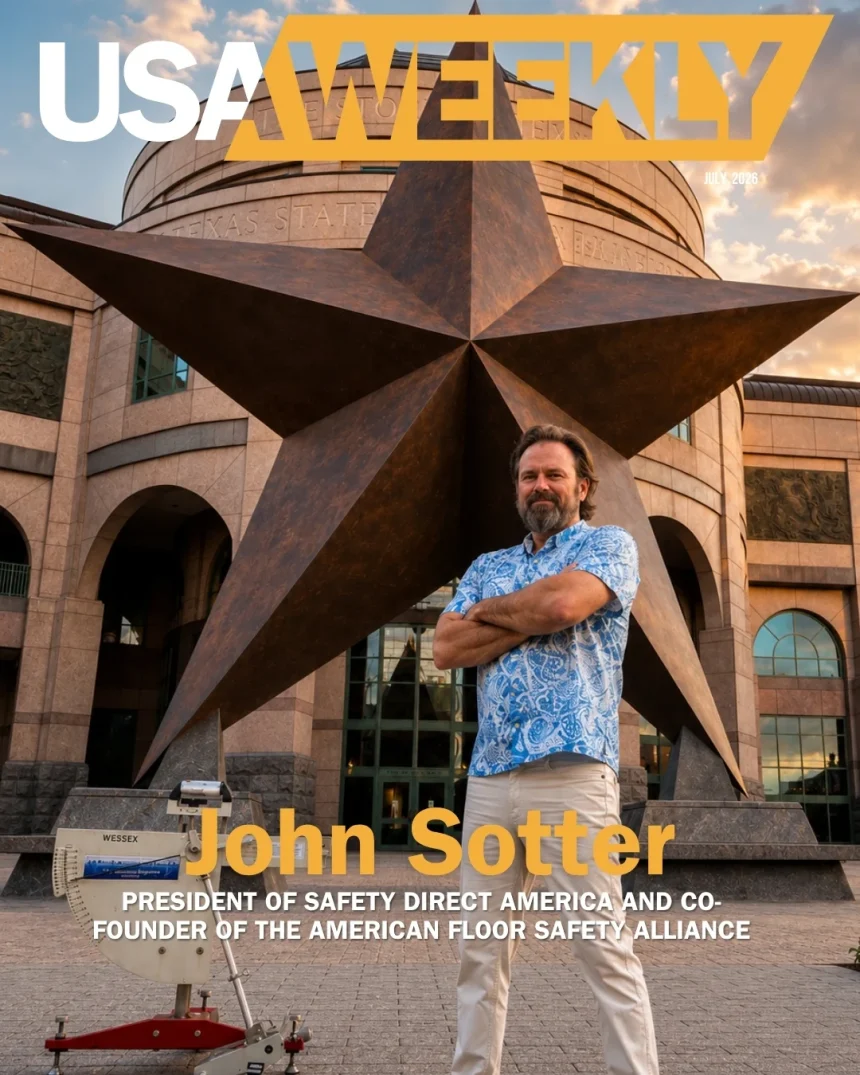
Most people never think about the floor beneath their feet.
They walk through office buildings, hospitals, hotels, schools, restaurants, shopping centers, and public sidewalks without questioning whether the surface is safe. It is only after someone slips and falls that attention turns to traction, flooring materials, maintenance practices, and testing standards.
For John Sotter, that moment often comes too late.
As president of Safety Direct America and Sotter Engineering Corporation, Sotter has spent decades studying one of the most overlooked public safety issues in the United States: floor slip resistance. While building owners, architects, attorneys, and facility managers frequently focus on visible safety measures, Sotter argues that the walking surface itself deserves far greater scrutiny.
His work has attracted increasing national attention throughout 2026. Publications including USA Today, LA Weekly, and International Business Times, have highlighted his efforts to improve floor safety through better testing methods, engineering, and public education. Together, those features paint the picture of a floor-safety expert who believes that preventable slip-and-fall injuries remain a national problem that deserves far greater attention.
A Career Focused on an Overlooked Safety Risk
Unlike many safety professionals who specialize in broad workplace compliance, John Sotter has concentrated his career on one specific challenge.
How do we measure how safe a floor is going to be for its intended use after installation?
It sounds like a straightforward question. Sotter argues that the answer has often been far more complicated.
According to Safety Direct America, Sotter has spent more than 25 years performing laboratory and field slip resistance testing for more than 1,000 clients across the United States, Canada, Mexico, and other locations. His work has included commercial buildings, public infrastructure, hospitality properties, transportation facilities, and legal investigations involving slip-and-fall incidents.
His background combines engineering, urban planning, chemistry, and practical field experience. After earning a degree in Urban Planning from the University of California, San Diego, he spent 17 years working in public safety for the City of San Clemente before expanding his work through Sotter Engineering.
That combination of government experience and engineering expertise has shaped his approach to floor safety.
Rather than treating slip resistance as a niche technical issue, Sotter views it as a public health concern.
Why Slip-and-Fall Prevention Matters More Than Ever
Falls remain one of the leading causes of injury in the United States, particularly among older adults.
As America’s population ages, healthcare professionals and safety experts increasingly warn that preventable falls could place growing pressure on healthcare systems while affecting the independence and quality of life of millions of seniors.
This demographic shift became a central theme of several national articles featuring Sotter during 2026.
A feature highlighted by USA Today examined his long-running effort to improve floor safety before accidents occur rather than responding after injuries have already happened. The article connected his work with broader concerns about an aging population and the growing need for safer homes, hospitals, businesses, and public facilities.
LA Weekly echoed those concerns by describing what it called a potential “slip-and-fall time bomb” as millions of Baby Boomers continue reaching retirement age. The publication emphasized Sotter’s belief that safer walking surfaces should become a larger part of national conversations about healthy aging and injury prevention.
For Sotter, these trends reinforce the importance of identifying hazards before injuries occur.
Year after year, the Centers for Disease Control (CDC) continues to report that the number one reason why people go to emergency rooms in America is falls, far surpassing car crashes and heart attacks, and every other form of injury. And the numbers will continue to explode as the average age of Americans gets older.
Building Safety Through Better Science
One of the defining themes throughout Sotter’s career has been his criticism of what he considers outdated or unreliable floor testing methods.
He argues that inaccurate testing can create false confidence about a walking surface’s safety.
Instead, Sotter advocates for testing procedures that more closely replicate real-world walking conditions and produce repeatable scientific measurements.
According to Safety Direct America, he played a significant role in updating ASTM E303-22, a pendulum-based dynamic coefficient of friction test used to evaluate slip resistance. The company states that his work helped strengthen the reliability of the testing method and improve consistency in floor safety evaluations.
His engineering philosophy centers on measurement rather than assumption.
Instead of relying solely on visual inspection or theoretical calculations, Sotter believes safety decisions should begin with objective testing supported by reproducible data.
That perspective has become a consistent theme across interviews and recent publications discussing his work.
Safety Direct America and Practical Floor Safety Solutions
John Sotter’s work extends well beyond consulting.
Safety Direct America provides slip resistance testing, expert witness services, engineering consultation, and anti-slip products designed for commercial, industrial, and residential environments.
The company’s work includes evaluating flooring materials, identifying hazardous walking surfaces, recommending corrective measures, and applying specialized anti-slip coatings across a wide variety of flooring types. These include concrete, terrazzo, ceramic tile, marble, granite, vinyl, wood, epoxy, and other surfaces.
Unlike companies focused exclusively on selling products, Safety Direct America emphasizes testing before recommending solutions.
That approach reflects Sotter’s broader belief that engineering decisions should follow measurement rather than marketing claims.
The company also provides expert witness services in slip-and-fall litigation, where accurate floor testing can become an important component of legal investigations.
Promoting Higher Industry Standards
Improving individual floors represents only part of Sotter’s broader mission.
He has also advocated for improvements in national floor safety standards.
That effort contributed to the formation of the American Floor Safety Alliance, an organization focused on advancing scientifically supported slip resistance testing and promoting more reliable evaluation methods throughout the industry. According to Safety Direct America, the alliance encourages objective testing and broader adoption of evidence-based standards.
Sotter argues that clearer standards benefit everyone involved.
Architects gain more reliable design guidance.
Building owners receive better information when selecting flooring materials.
Facility managers can make more informed maintenance decisions.
Attorneys obtain more objective evidence during litigation.
Most importantly, pedestrians benefit from safer walking surfaces.
Education Beyond Engineering
Another notable aspect of Sotter’s work is his emphasis on public education.
Rather than limiting technical knowledge to industry professionals, he has published educational articles and videos explaining floor safety concepts in language that building owners, homeowners, architects, and the general public can understand.
Topics include slip resistance testing, anti-slip coatings, aging populations, commercial floor maintenance, legal standards, and common misconceptions surrounding floor safety.
This educational approach reflects an understanding that engineering alone cannot reduce slip injuries.
Awareness also matters.
When property owners better understand how flooring materials behave under wet or contaminated conditions, they become more likely to implement preventive measures before accidents occur.
National Recognition in 2026
The increased visibility surrounding John Sotter during 2026 reflects growing interest in preventive safety rather than reactive risk management.
CEO Monthly highlighted Safety Direct America’s efforts to combine engineering, international research, and practical field testing to improve floor safety. The publication described the company’s emphasis on scientifically defensible methods and its role in encouraging more accurate evaluation standards.
International Business Times published multiple articles discussing Sotter’s concerns about unreliable testing methods and the importance of modernizing floor safety practices. Those features examined broader questions surrounding measurement accuracy, industry standards, and the need for greater accountability within the field of slip resistance evaluation. Especially within the community of full-time expert witnesses, who have created their own tests that lack published test standards in any nation, and who have taken over the ASTM floor slip resistance committee to ensure there are no test methods published for assessing the safety of a floor.
Together, these publications introduced Sotter’s work to a wider audience while drawing attention to a topic that often receives little public discussion until after serious injuries occur.
Looking Ahead
As America’s population continues to age, experts expect fall prevention to remain a growing public health priority.
Healthcare providers, engineers, architects, and policymakers increasingly recognize that preventing injuries often costs far less than treating them.
Within that conversation, John Sotter continues advocating for a straightforward principle.
Better science leads to better safety.
His work suggests that safer buildings begin not with warning signs after accidents happen, but with reliable testing before doors ever open to the public.
Whether evaluating a hospital corridor, a hotel lobby, a restaurant entrance, or a residential bathroom, Sotter believes the same question should guide every project.
Can this floor be trusted under real-world conditions?
A Career Built on Prevention
John Sotter’s career demonstrates how highly specialized engineering can produce broad public benefits.
Instead of pursuing attention through dramatic innovations, he has dedicated his professional life to improving an everyday element that most people rarely notice until something goes wrong.
Through Safety Direct America, he has positioned himself as one of the leading voices in American floor safety through engineering research, expert consulting, public education, and advocacy for stronger testing standards.
He has led a shift toward preventative practices rooted in proven, reliable, internationally accepted measurable science rather than assumptions and instruments developed by American full-time “expert” witnesses who make their living testifying in courtrooms, being deposed, and writing reports, rather than testing floors for injury prevention every single day of the week. There’s a massive difference between people who want to make the world a better place through injury prevention and people who want to win lawsuits at any cost.
For millions of Americans who walk across commercial buildings, healthcare facilities, workplaces, and public spaces every day, that work may ultimately prove more important than many people realize.
Because in the end, the safest floor is the one no one ever has to think about.