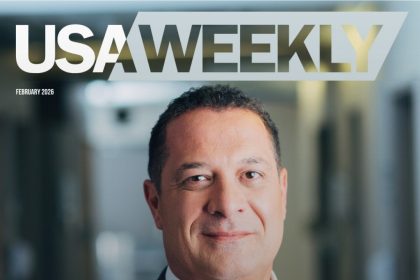


For most founders, volatility is something to manage around the edges. For Gerard Coombs Jr., it is built into the business model.
As CEO of Arvida Labs, the manufacturing company behind Mellow Fellow, Coombs operates in a category where a change in state law can force packaging updates, product returns or reformulation with little warning. Federal policy is even more consequential. Under a law passed in November 2025, the federal definition of hemp is scheduled to change on Nov. 12, 2026, adding a total-THC standard and a 0.4 milligram-per-container limit for certain final hemp-derived cannabinoid products. Unless Congress changes course, many products that qualify as hemp today could fall outside that definition later this year.
Congress is still debating alternatives. A bipartisan House proposal introduced this summer would create a federal regulatory structure for hemp products, including testing, labeling and a minimum age of 21, rather than simply allowing the current restrictions to take effect unchanged. Meanwhile, President Donald Trump has personally weighed in on a proposed short delay to the coming hemp restrictions, highlighting how unsettled the policy landscape remains even months before the deadline.
For Coombs, that uncertainty has made one skill unusually valuable: the ability to build a company that can change without losing its footing.
“It’s very hard to plan and run a business like a traditional business,” Coombs told me.
He points to something as basic as annual forecasting. A company can project demand, extend payment terms to customers and plan inventory based on the rules in place today, only to have those assumptions change when a state rewrites its requirements.
“You do your sales forecast every year, and then it’s just hard to forecast what states are going to change and when they’re going to change,” he said.
That is not theoretical. Coombs described regulatory changes in Florida that required products to be returned, relabeled or repackaged. In other states, a change in product eligibility can affect what retailers can carry and what manufacturers can ship.
The lesson has been to avoid building a company around regulatory permanence.
“You need to be efficient, you need to be lean,” Coombs said. “And you have to be prepared. We have to be prepared to pivot at any moment.”
Building Optionality Into The Business
The pivot Coombs describes is no longer hypothetical. The new standard switches on Nov. 12, and it reaches finished products rather than the plant, which puts it directly on the shelf.
Forbes recently estimated the U.S. hemp sector at roughly $28 billion and more than 300,000 jobs, while the THC beverage category alone has reached hundreds of millions of dollars in measured retail sales. Those businesses now face a federal framework that could reshape large parts of the market in a matter of months.
Coombs is not betting that one regulatory interpretation will survive indefinitely. His longer-term view is that hemp and state-regulated cannabis are likely to move closer together.
“I think more states are going to move towards recreational,” he said. “I think eventually it’s going to be a world where cannabis, hemp are one.”
That convergence is already visible. Hemp companies are looking at licensed cannabis markets for greater regulatory certainty, while established cannabis operators have explored hemp-derived products and adjacent channels.
For Arvida Labs, the practical response has been diversification. Coombs said the company is moving into regulated cannabis markets while maintaining the ability to serve existing cannabinoid categories where permitted.
The strategy is less about predicting exactly what Washington will do and more about avoiding dependence on a single outcome.
Regulation As Infrastructure
Coombs is direct about what he thinks the industry needs.
“I think it would be great if they just legalize it and just put in reasonable regulation,” he said. “We need to be treated like any other business.”
What he is describing is consistency rather than deregulation. That includes clearer testing requirements, restrictions designed to keep products away from minors and enforcement against operators that do not meet established standards.
“Just make sure that the operators are operating responsibly,” he said. “And we need to do that through regulations and enforce it.”
For years, the cannabinoid market benefited from a patchwork of federal and state rules that created room for rapid innovation. It also created uncertainty around testing, labeling, manufacturing and distribution. The coming federal changes are partly an attempt to address that gap, but industry groups argue that prohibition without a workable regulatory pathway could simply replace one form of uncertainty with another.
Coombs sees the lack of uniform standards as one of the central problems.
“There are bad actors,” he said. He also pointed to inconsistent state requirements, including jurisdictions that do not require the same testing panels or batch-testing standards.
When he speaks with lawmakers, he said, technical complexity often has to be reduced to a few basic points.
“I have to go with three bullet points,” he said. “This is what we need to do. Here’s why we need to do it, and this is how you do it.”
A Leadership Model Built Around The Pivot
There is a broader business lesson in Coombs’ experience.
The instinct in a volatile market is often to wait for certainty before making major investments. But in some industries, certainty never arrives. Coombs has taken the opposite approach and built systems capable of absorbing change.
That means remaining lean enough to reformulate, repackage or redirect inventory, and creating multiple market channels rather than relying on one regulatory lane. It also means accepting that forecasting in a fast-moving category may never look like forecasting in a conventional consumer packaged goods company.
His advice to anyone thinking about entering the space starts as a joke.
“Don’t do it,” he said. Then the real answer. “If you’re passionate about it, right, and you put out a good product, and you’re consistent, and you do things right, you can.”
The caveat is the part that matters most. For founders outside hemp it may be the part that travels furthest, because regulation, technology and consumer behavior can all change faster than a five-year plan.
“Just understand that you need to be efficient, you need to be lean,” Coombs said. “That’s the industry that we’re in. And until there’s more stability, you just have to understand what you’re getting into.”