
AI that reviews jail calls and camera feeds invites a fair question: who decides? The answer separates tools agencies can defend from tools they cannot.
When AI enters public safety, the debate usually starts with what the technology can do. The better question is who decides what happens next. Software can read more calls than any team could ever listen to. It should never be the one that acts on them.
METR and Anthropic lead the headlines for responsible ai but one other leading company LeoTech is making headlines for doing so in the correctional facility industry.
The volume problem
Corrections agencies record enormous volumes of calls. Leo Technoologies reports that its Verus platform has transcribed, translated, and analyzed 5.7 billion minutes of communications. No team can review that by ear. The job of AI is to narrow it: to turn that volume into a short list of prioritized, investigator-ready leads.
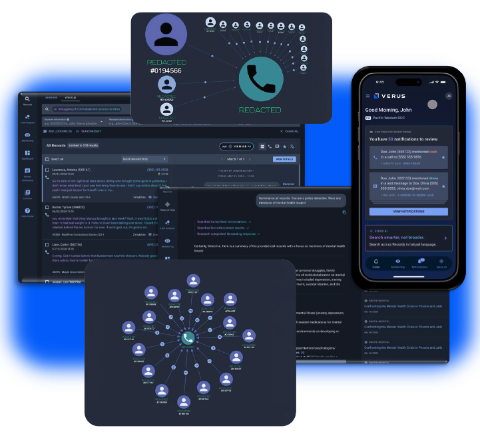
Verus AI does that with transcription, translation, keyword and natural-language search, link analysis that maps who is talking to whom, and continuous monitoring that flags content for review.
What is under the hood
Behind that short list sits a set of distinct capabilities. Automatic speech recognition converts audio into text, and neural machine translation handles calls in other languages. A curated lexicon tracks key terminology and language trends in call data, while SearchAssist, a patent-pending recommendation model, identifies similar terms, including slang and misspellings, in the context of the conversation.
Link analysis turns relationships into visuals, so investigators can see key contacts at a glance. Verus ID integrates Thomson Reuters CLEAR to add enriched details about the person on the receiving end of a call. Digital mail scanning applies the same logic to jail correspondence. Report writing automates key parts of investigative analysis so reports are produced faster and more consistently. Continuous monitoring runs automated searches and manages alerts in the background, and voice biometrics can match and identify individuals across recorded communications.
None of these is a decision. Each is a way to give a person better information sooner.
Principle one: AI narrows, people decide
Verus AI is built as human-in-the-loop AI. It surfaces leads and alerts, and investigators make every decision. The same rule holds for Verus Vision AI, LeoTech’s video product, where prioritized alerts route to the right staff and every key decision stays with an officer.
Why human review is not optional
Slang changes. Context changes the meaning of a word. A phrase that signals a threat in one call is harmless in the next. A model can propose and prioritize, but it cannot be held accountable for being wrong, and an agency cannot hand its judgment to software and then answer for the outcome.
That is the practical case for human-in-the-loop design. LeoTech describes AI as a force multiplier: it accelerates actionable information while investigators remain the decision makers. The system’s job is to make sure the right call reaches the right person early. The person’s job is to decide what it means.
Knowing who is speaking
One of the more sensitive capabilities in the Verus AI toolkit is voice biometrics. LeoTech says the technology can match and identify individuals across recorded communications, so agencies can find known voices within very large sets of recordings. Used well, it helps investigators follow one speaker across calls when phones, PINs, or accounts change.
It also raises the stakes for oversight. Voice data is biometric data, and the rules for recording, notice, and retention vary by state and by agency policy. That is one more reason the technology belongs in the hands of trained staff, inside a process the agency’s counsel has reviewed, with a person confirming any match before it is relied on.
Principle two: show your work
Look at the question typed into the screenshot above, and at the lines beneath it. The system lists what it searched, transcribed conversations first and law enforcement reports next, before it generates an answer.
That visibility is not a nicety. In Verus ION, LeoTech’s platform for connecting an agency’s data, findings arrive with source attribution and evidence chains. An answer an investigator cannot trace is an answer an agency cannot defend in an audit or an oversight hearing.
Accountability is a feature you can measure
Accountability should leave a record. LeoTech reports that its platform has logged more than 7 million user actions in its audit log. That matters because oversight bodies and county boards tend to ask the same question after any incident: who looked at what, and what did they do about it?
An audit trail answers it. Combined with source attribution and evidence chains in ION, it lets an agency show not only what the system flagged, but how a person handled it. That is the difference between technology agencies can defend and technology they merely deploy.
Principle three: the agency owns its data
LeoTech says agencies keep full ownership and control of their data. For agencies that answer to legislators, county boards, and the public, that is a design requirement, not a feature.
Ownership matters in practice. If an agency changes vendors, it should not have to wonder who holds its recordings, transcripts, and analysis. It matters, too, when a public records request or a legislative inquiry arrives and the agency needs to find and produce what it holds.
What it looks like in practice
Take wellness. Communication analysis can help identify incarcerated people in distress so they can be connected to care before a crisis. The flag goes to staff, who decide what happens next.
Or take safety on the floor. Verus Vision AI adds an analytics layer to a facility’s existing cameras and reads live and recorded footage. Its listed capabilities include automated inmate counts, aggressive behavior alerts, isolation detection, person-down monitoring, detection of detainees converging on staff, social network analytics, PREA-related behaviors, and self-harm indicators. Prioritized alerts go to the people who can respond, and an officer verifies each alert with the supporting video before anything else happens. That gives the agency an auditable evidence trail.
Or imagine a long investigation. A detective who once spent days listening for a single reference can search transcripts in natural language, see connections in a link analysis graph, and let the system draft parts of the report. The detective still verifies each piece, edits the report, and owns the conclusion.
Five questions for any leader deploying AI
- Who makes the final call? If the answer is the software, stop.
- Can the system show where an answer came from? If not, you will not be able to explain it later.
- Who owns the data? Make sure the answer is you.
- What record does the system keep of who used it and when? Without one, you cannot answer an oversight question.
- How does it treat communications that should never be reviewed, such as attorney-client calls? Ask the vendor to explain it in plain language.
Trust in AI is not won by what it can do. It is earned by what it leaves to people, and by how clearly it shows its work.