
| 17 YEARS Zero Failures | 12 YEARS Fugitive Life | 24 FELONIES None Committed | $2,400 Left When He Ran | 10 YEARS 3× Guidelines |
In 1993, two federal agents led a man in handcuffs the long way through downtown Jackson, Tennessee — past the coffee shops, past the lunch crowd, past the business associates who had spent years shaking his hand and calling him a hell of an operator. They chose the longest possible route on purpose. They wanted him seen. What they could not have known is that one day, the man at the end of those handcuffs would write it all down — every betrayal, every rigged hearing, every night sleeping under a stolen name — and the world would finally hear it.
That man is R.J. Morell, and his memoir The Man They Tried to Destroy is one of the most riveting, enraging, and ultimately triumphant true stories to arrive in American publishing in years. It is the kind of book that makes you read with your jaw clenched — not because it’s sensational, but because every outrage in it is documented, sourced, and told with the measured precision of a man who has had forty years to make sure he gets every single word right.
Seventeen Unbroken Years — Then the Floor Gave Way
Before the handcuffs, before the stolen identity, before the prison cell in San Quentin, there was the real estate empire. From 1964 to 1981, Morell built, sold, and converted properties across Northern California — subdivisions, apartment conversions, condominium projects stretching from Redding through Contra Costa County and across the Central Valley. In seventeen years in business, he never had a single losing project. He never suffered a foreclosure. Not once. He took fifty-one mayors out on his own boat to tour a harbor he was developing. He stood as an honored guest at the ribbon-cutting of a brand-new county jail, champagne in hand — a detail the memoir returns to with devastating irony.
When the California real estate market collapsed in 1981 and interest rates surged toward seventeen percent, Morell was not just unprepared. He was, in his own brutally honest accounting, undone by the very confidence that had made him great.
BY THE NUMBERS: THE RISE AND FALL OF R.J. MORELL
- 17 consecutive years in California real estate — zero foreclosures, zero failed projects
- 51 mayors hosted on his private boat for a harbor development tour
- Entire estate transferred to his own attorney and employee — on a promise, from a hotel room 2,000 miles away
- $0 of the alleged “stolen” funds ever passed through his hands — backed by hidden cancelled checks the prosecutor possessed
- 24 felony counts — convicted of crimes committed against him while he was in Tampa, Florida
- $2,400 in cash the day he became a fugitive — the man newspapers called an “eleven-million-dollar thief”
- 12 years living under a purchased identity — operating at the level of state governors
“I told myself the depression was going to ruin my competitors and leave me standing,” Morell writes with the self-awareness of a man who has spent decades cross-examining his own ego. “I was forty years old and I had never once been wrong about the business in my entire adult life. So when the storm came, I did not batten down. I stood out on the deck and told myself the storm was for other ships.” It is a confessional that sets the moral tone for everything that follows: Morell is not interested in being a sympathetic martyr. He is interested in the truth, and the truth, as he sees it, includes himself.
The Betrayal That Built the Case Against Him
Enter Dick Larscheid — an employee Morell had known since the man was a teenager selling Christmas trees on one of his lots, a man whose business failures Morell had personally bankrolled out of loyalty. And enter William L. Cowin, an attorney Larscheid recommended for the firm. Together, while Morell was in Tampa chasing hotel deals, these two men called him with a crisis: an involuntary bankruptcy had been filed, a trustee was coming, and the only way to save the estate was to temporarily convey the properties into their names. Morell signed his entire life’s work over to them. From a hotel room in Florida, on a promise.
They never returned a single property of value. Morell writes in forensic detail about how Larscheid used his assets to pay off his own debts to unrelated businessmen — “I was robbed to pay for a robbery” — while Cowin kept the best parcels for himself, returning only the least valuable scraps, and those burdened with delinquent taxes.
They did not simply take my property. They took my property — and then the District Attorney turned around and charged me with the very frauds that had been worked against me, and a jury of twelve ordinary citizens convicted me of crimes that other men had committed with their own hands while I was two thousand miles away in a hotel in Florida.
R.J. MORELL, The Man They Tried to Destroy
A Prosecutor’s Hidden Files — and the Most Convenient Fire in Legal History
The memoir’s central chapters on the criminal trial read like a legal thriller — except every detail carries the weight of a man’s destroyed life. Morell documents in precise, maddening detail how the Contra Costa County prosecutor possessed cancelled checks proving that the money in question went directly into another man’s personal bank account — not Morell’s. He had those checks. He hid them. He stood before twelve jurors and convicted Morell of pocketing money that his own evidence proved had gone elsewhere.
The exculpatory documents existed; they were admitted into evidence with the truth redacted, blacked out, so that jurors could see the papers but not read what they said in Morell’s defense. An innocent woman who held documents helpful to the defense was simply never called to the stand.
And then there was the attorney. John McCardle — hired for Morell’s last twenty-five thousand dollars, handed three to four feet of annotated original documents built painstakingly by Morell himself over eight months — who showed up to trial carrying a thin leather briefcase with nothing in it. His explanation? A fire. The documents had burned. “A fire,” Morell writes. “In the one house in the entire state of California where the one stack of documents that could have cleared me happened to be sitting.” He doesn’t believe it. He has never believed it. And after reading how he describes it — the timeline, the circumstances, the beneficiaries — you won’t believe it either.
Twelve Years in Plain Sight
THE FUGITIVE YEARS: A TIMELINE
| 1982 | September 22 — Morell kisses his 12-year-old daughter goodbye, hides his tears, and disappears. He has $2,400 in his pocket. |
| 1982–84 | Purchases a complete new identity through an underground network. Begins rebuilding — from nothing, in towns no one knows him. |
| Mid-1980s | Under his new name, enters hotel management. His skills are undeniable — he rises. Two state governors dine at tables he personally dressed. |
| 1990–93 | Operating in West Virginia and Tennessee as a respected hospitality executive. His wife follows him into exile. They raise their children in the middle of a storm he made. |
| 1993 | A single mistake — “the one thing I did wrong” — leads the FBI to Jackson, Tennessee. Two agents march him the long way through downtown. He keeps his chin up the entire four blocks. |
| 1993–98 | Contra Costa County. San Quentin. Carson Section. A sentence three times what state guidelines required. He does his time — alone, by his own rule — and he fights. |
What makes the fugitive section of this memoir so extraordinary is not the adventure of it — though the adventure is genuine, the man built a second life so respectable that sitting governors attended his events — but the psychological honesty of it. Morell does not romanticize the running. He describes the cheap motel rooms, the jumps at every knock on a door, the sleepless nights prosecuting himself in the dark. He describes writing to his grandson in prison right now — “Nick, who is reading these pages a few at a time, in a place I know far too well” — and the image of an old man in Sebring, Florida, mailing chapters of his life to a boy in a South Carolina cell, is the emotional fulcrum around which the entire book turns.
Why This Book Lands Right Now
In an era of renewed national attention on prosecutorial misconduct, wrongful conviction, and the hidden machinery of the American justice system, The Man They Tried to Destroy arrives with an unusual authority: it is not written by an activist or a journalist. It is written by a man who lived it, who can name the cancelled checks and the name on the account and the prosecutor who hid them, who can describe the exact weight of the sentence handed down three times above the guidelines by a judge he never forgave.
“I have not dressed myself up in these pages,” he writes in the Author’s Note. “I had a flaw that built me and then helped wreck me, and I am going to name it for you on the very first page, before anyone else can. But I am also going to say the thing I have been saying for four decades, the thing this whole book exists to prove: I was not the criminal they made me out to be.”
He told his daughter to have a wonderful day, sweetheart, the way he had a thousand mornings before — and then he turned his face away so she would not see his tears. He walked out his front door and vanished. He came back, eventually, in handcuffs, and served years of someone else’s crimes in California’s hardest prisons, and he came out the other side with his spine straight and his mind intact and a story that the State of California spent decades trying to ensure no one would ever hear.
It did not succeed. He is still here. And so is the truth.
| AVAILABLE NOW · AMAZON The Man They Tried to Destroy A Memoir by R.J. Morell One of the most riveting, enraging, and ultimately triumphant true stories to arrive in American publishing in years. Available now on Amazon in print and digital editions. amazon.com → Search: “The Man They Tried To Destroy RJ Morell” |
ABOUT THE AUTHOR
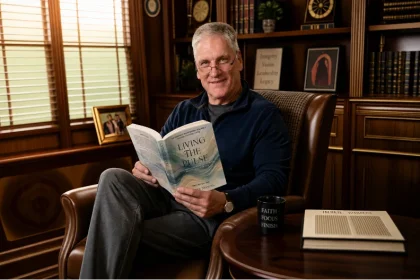
R.J. Morell
R.J. Morell is the author of The Man They Tried to Destroy: A Memoir (2026). A former California real estate developer whose career spanned seventeen unbroken years and millions of dollars in Northern California property, Morell spent twelve years as a fugitive under a purchased identity before serving time in the California prison system for crimes he maintains — with documented evidence — were committed against him, not by him. He lives in Sebring, Florida. He is writing for his grandson.
© 2026 USA Weekly · The Man They Tried to Destroy by R.J. Morell is published by PublishaBook.co and available exclusively on Amazon.