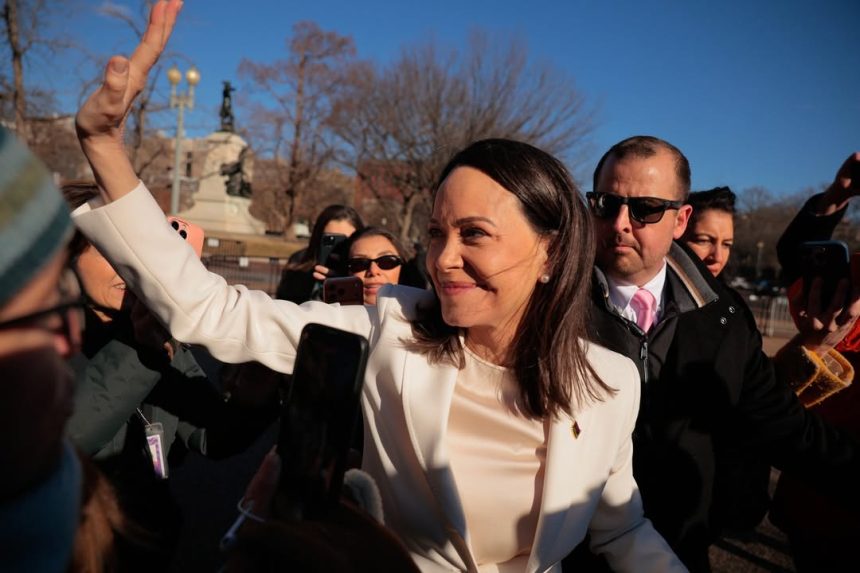
María Corina Machado, the prominent Venezuelan opposition leader, made headlines on Thursday with her visit to the White House, where she brought along a symbolic gift: a Nobel Peace Prize that she had received in recognition of her efforts against the Maduro regime. The meeting with U.S. President Donald Trump was highly anticipated, both for its political implications and for the potential boost it could have provided to Machado’s standing amidst Venezuela’s ongoing crisis.
Upon entering the White House, Machado handed the prestigious award to Trump, who has long expressed admiration for such recognitions. However, she left the meeting with little more than a swag bag and vague assurances regarding the future of her political aspirations and efforts to overthrow Nicolás Maduro, the contested president of Venezuela.
Machado has emerged as a key figure in Venezuela’s struggle for democracy, advocating for a peaceful transition of power and for international support in the fight against government oppression. During her visit, she discussed various topics, including humanitarian aid, the current economic turmoil in Venezuela, and the regime’s brutal grip on power.
The backdrop of Machado’s meeting with Trump comes as Venezuela continues to face a dire humanitarian crisis, exacerbated by years of political instability and economic mismanagement. Over 7 million Venezuelans have fled the country, making it one of the largest migration crises in Latin America. The plight of her fellow citizens weighs heavily on Machado, who has dedicated her life to restoring democracy in her homeland.
Machado described her meeting with Trump as an opportunity to present the realities of the situation in Venezuela to a powerful ally. “It was important for me to talk about the urgency of the humanitarian crisis and the need for immediate assistance for the Venezuelan people,” she stated after the meeting. However, she expressed disappointment at the lack of concrete commitments made during her discussions with U.S. officials.
In recent years, the U.S. has taken a firm stance against the Maduro regime, imposing sanctions aimed at crippling the Venezuelan economy. This aligns with Machado’s vision of international intervention as the necessary catalyst for change. Yet, the lack of a robust plan of action discussed with Trump has left her feeling uncertain. “I was hoping for a stronger commitment to carry our message forward,” she reflected.
This meeting did not just serve as a personal encounter for Machado and Trump; it also illustrated the complexities of international diplomacy in addressing human rights issues. While Machado seeks to bring global attention to the suffering of Venezuelans, the U.S. administration’s focus remains on political considerations and electoral strategy as it heads towards forthcoming elections.
During her time in Washington, Machado also participated in a series of meetings with various policymakers and think tanks. These discussions focused on pathways to restoring democracy and addressing the humanitarian disaster, providing her with platforms to amplify her message.
However, despite her efforts, some of those she met with reportedly remained skeptical about the prospects of substantial aid or intervention. Observers noted that international interest may wan due to myriad other pressing global concerns, leaving leaders like Machado grappling for attention and resources in a world that seems to have moved on. Machado recognized this challenge, stating, “Venezuela often gets overshadowed by other global issues, yet our people continue to suffer.”
As Machado departed the White House, she left with a sense of urgency but also uncertainty. The swag bag she received—generally filled with mementos and gifts for visitors—served as a bitter reminder of the mismatch between the recognition her contributions garnered and the tangible support she ultimately received.
Looking ahead, Machado remains hopeful but realistic about her quest to secure a better future for Venezuela. She affirmed her commitment by stating, “I will continue to fight for the Venezuelan people, driven by the hope that change is possible.” Yet, as the political landscape shifts and without more decisive action on part of the U.S., the path forward remains challenging for both her and the many Venezuelans she represents.
In a time fraught with uncertainty, the onus now rests with both foreign leaders and Venezuelan citizens to find a way to navigate the clouds of despair that have settled over their nation. Machado’s visit to the White House highlighted not only her resilience but also the complexities that lie ahead in the fight for democracy in Venezuela.