
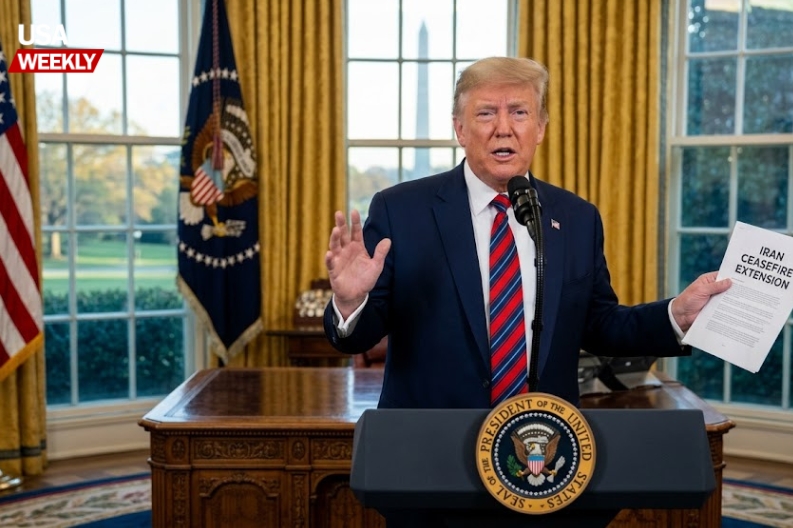
President Trump extended the U.S.-Iran ceasefire extension with no firm end date. However, the naval blockade stays in place. Here's what that means for oil markets and everyday Americans at the pump.
⚡ Quick Facts: Iran Ceasefire Extension at a Glance
- Status Iran ceasefire extension announced, indefinite, no fixed end date
- Announced by President Donald Trump via Truth Social, April 22, 2026
- Reason for Extension Pakistan’s request; Iran yet to submit a unified peace proposal
- Blockade Status U.S. naval blockade of Iranian ports remains in place
- Brent Crude Fell 0.2% to $98.27 per barrel
- WTI Crude dropped to $89.39 per barrel
- Next Talks Peace negotiations scheduled in Islamabad, Pakistan
Trump Extends Iran Ceasefire, But Keeps the Blockade On
On Tuesday, April 22, 2026, President Donald Trump announced an extension of the Iran ceasefire with no set deadline. This came as a surprise. Just hours earlier, Trump had publicly said he was against extending the truce. However, he changed course after Pakistan stepped in as a mediator.
Trump posted on Truth Social: “I have therefore directed our Military to continue the Blockade and, in all other respects, remain ready and able.” He added that the ceasefire would last “until such time as their proposal is submitted, and discussions are concluded, one way or the other.”
In short, there is no ticking clock, but there are clear conditions. Iran must bring a “unified proposal” to the table. Until then, the naval blockade continues.
Why Did Pakistan Step In? The Role of a Key Mediator
Trump credited Pakistani Field Marshal Asim Munir and Prime Minister Shehbaz Sharif for asking him to hold off. Furthermore, Sharif publicly thanked Trump and called for both sides to move toward a permanent peace deal.
I sincerely hope that both sides will continue to observe the ceasefire and be able to conclude a comprehensive Peace Deal during the second round of talks scheduled at Islamabad.
- Pakistani Prime Minister Shehbaz Sharif, April 22, 2026 (via X)
Therefore, Islamabad is not just hosting the next round of talks – it is actively shaping the outcome. This gives Pakistan a rare and powerful seat at the table in one of 2026’s most dangerous conflicts. For background on Pakistan’s diplomatic role in Middle East conflicts, see this Al Jazeera report on the ceasefire announcement.
How Did Iran React? Tehran Stays Quiet, For Now
Iran did not immediately respond to Trump’s post. However, the semi-official Tasnim news agency said Tehran’s official position would be announced later.
Earlier, Iranian Foreign Minister Abbas Araghchi called the U.S. naval blockade an “act of war.” He also said it was a clear violation of the existing ceasefire terms. Despite this, Iran has not yet walked away from the peace process.
Is Iran’s Leadership Really “Fractured,” as Trump Claims?
Trump suggested Iran’s government is “seriously fractured,” and that this is slowing peace talks. However, Al Jazeera’s Tehran correspondent Ali Hashem strongly disputed this view. He explained that the new supreme leader, Mojtaba Khamenei, who replaced his assassinated father last month, leads a tight-knit team that has worked together for 15 years.
In other words, internal divisions in Tehran may be smaller than Washington believes. You can read more about the Strait of Hormuz dispute in this detailed Al Jazeera explainer on the Hormuz closure.
Oil Prices React: What This Means for Your Gas Bill
As soon as news of the Iran ceasefire extension broke, oil markets responded. Traders saw less risk of an immediate attack on Iranian oil infrastructure. As a result, crude oil prices eased.
| Commodity | Price | Change | What It Means |
|---|---|---|---|
| Brent Crude | $98.27/bbl | ▼ 0.2% | Global oil benchmark slightly lower |
| WTI Crude | $89.39/bbl | ▼ 0.3% | U.S. benchmark falls; pump relief possible |
| S&P 500 Futures | – | Mixed | Markets cautiously optimistic |
| U.S. Gas Prices | ~$4.12/gal (avg) | Slight ▼ expected | Analysts expect small drop by weekend |
Analysts suggest that if the ceasefire holds for another week, Americans could see a modest drop at the pump by the weekend. However, the blockade still blocks Iranian crude exports. Therefore, prices will not fall sharply unless the Strait of Hormuz fully reopens. For more on how oil conflicts affect everyday prices, check CNN’s analysis of the U.S.-Iran negotiations.
What the U.S. Actually Wants From Iran
Washington’s demands are sweeping. The U.S. is pushing for three key things:
- Full shutdown of Iran’s nuclear program: no enrichment, no new centrifuges
- Limits on Iran’s missile production: particularly long-range ballistic missiles
- End to Iran’s support for regional allies: including Hezbollah and Hamas
Iran, however, insists on its right to enrich uranium. Consequently, the gap between both sides remains wide, even with the ceasefire extended.
Quick Timeline: How We Got Here
- Feb 28, 2026: U.S. and Israel launch first strikes on Iran
- March 9, 2026: Mojtaba Khamenei named Iran’s new supreme leader
- April 8, 2026: Initial two-week ceasefire agreed
- April 18, 2026: Iran closes the Strait of Hormuz again over blockade
- April 21, 2026: Trump says he opposes extending the ceasefire, then reverses
- April 22, 2026: Iran ceasefire extension announced indefinitely
What Happens Next? 3 Things to Watch This Week
1. Iran’s Official Response
Tehran has not officially responded. Additionally, whether Iran shows up to the Islamabad talks will determine if this ceasefire means anything at all.
2. The Strait of Hormuz
The blockade controls roughly 20% of the world’s oil supply. As long as it stays in place, global energy markets will stay nervous. Watch Al Jazeera’s documentary on the Strait of Hormuz threat.
3. U.S. Gas Prices by the Weekend
Watch the national average closely. Furthermore, if WTI stays below $90, analysts expect pump prices to dip slightly before Friday.
Bottom Line: A Fragile Pause in a Dangerous Conflict
The Iran ceasefire extension is real, but it is fragile. Trump extended it with no fixed deadline, yet kept the naval blockade running. Iran has stayed silent. Pakistan is working hard to bring both sides back to the table. Meanwhile, oil markets are watching every tweet, every statement, and every tanker in the Strait of Hormuz.
For everyday Americans, the direct impact lands at the gas station. A lasting ceasefire could bring real relief. However, if talks fail and the blockade tightens, prices could spike again fast.
Ultimately, the Iran ceasefire extension is a window, not a solution. Whether leaders on both sides use that window wisely will shape not just the Middle East, but the American economy for months to come.