
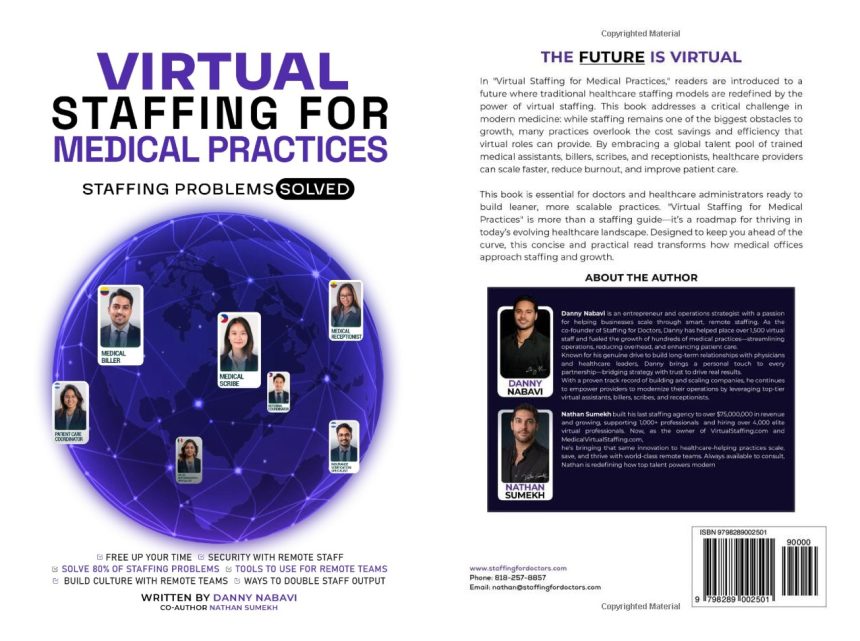
If you own a medical practice today, you already know how challenging staffing has become. Finding reliable people, keeping them, training them, and making sure the workflow never breaks – none of it is easy. Since COVID, the problem has only grown. Many practices feel stuck, overwhelmed, and short-staffed, no matter how many hiring ads they post.
This is exactly the world Nathan Sumekh and Danny Nabavi step into with their new book on virtual staffing for medical practices. With more than six years of experience placing medical virtual staff and working with thousands of healthcare providers, Nathan and Danny have seen the staffing struggle up close. Their insights are not theories; they’re lessons collected from real clinics, real challenges, and real growth.
The book is written to be a practical, simple, and clear guide for any medical practice owner who wants to modernize their team, reduce burnout, and scale smoothly. In this article, we’re breaking down the biggest lessons Nathan and Danny want all practice owners to understand.
Lesson 1: Your Hiring Radius Is No Longer 15 Miles, It’s the Entire World
One of the strongest messages Nathan and Danny share is that most practices limit themselves without even realizing it. They hire only within a 10 to 15 mile radius, hoping to find someone with experience, reliability, and the right skills. But the truth is that a small radius is exactly why it takes so long to find good people.
Nathan and Danny explain that virtual staffing changes this entirely. Instead of being restricted to your neighborhood, you gain access to a global pool of medical talent – highly educated, trained, and eager professionals from countries like the Philippines, Nicaragua, Ecuador, and the Dominican Republic.
Here’s the surprising part: these professionals aren’t just “good enough.” Many of them have three to five years of experience in dentistry, internal medicine, cardiology, dermatology, and more. They’re already familiar with medical processes, EMRs, insurance verification, and patient coordination.
You’re not lowering the bar. You’re expanding the horizon.
Lesson 2: Virtual Staffing Is Not Outsourcing
This is a major misconception that Nathan and Danny clear up throughout their book.
Most people confuse virtual staffing with outsourcing or call-center models but Nathan and Danny explain there’s a huge difference.
Outsourcing often means:
- Shared staff
- Multiple clients per agent
- Little control
- Limited training
- No direct integration
- Call-center environments Virtual staffing, however, means:
- Dedicated staff who work only for your practice
- Full-time, 40 hours per week
- HIPAA-compliant and medically trained
- Integrated into your EMR, EHR, and phone system
- Working your hours and your workflow
- Functioning like local employees, just remote
This distinction is key. Nathan and Danny emphasize that virtual staff are not meant to replace local teams; they’re meant to support them, reduce burnout, and make the entire practice more efficient.
The goal is to create a blended workforce, with local staff focusing on in-person care, while virtual staff handle the tasks that often slow practices down.
Lesson 3: Virtual Staff Improve Patient Experience in Ways You Don’t Always See
A powerful insight from Danny’s interview and book is how much virtual staff can improve the patient experience, even though patients may never see the work happening behind the scenes.
Here’s the reality: many practices are overwhelmed. Phone calls are missed. Voicemails stack up. Prior authorizations get delayed. Patients sometimes feel ignored, not because the practice doesn’t care, but because the team simply can’t keep up with the workload.
Nathan and Danny show how virtual staff help solve this:
- They return calls faster
- They follow up on prescriptions and lab results
- They handle insurance verification
- They update EMRs and notes
- They schedule appointments and coordinate referrals
- They communicate more often, not less
When your team isn’t drowning in administrative work, they can finally give more attention to the patients standing right in front of them.
Better workflow → better care → better experience.
Lesson 4: Global Talent Is Far More Skilled and Committed Than Many Think
One of Danny’s biggest frustrations is the stereotypes people still have about international staff. He addresses this directly.
Many practice owners assume:
- Their English won’t be strong
- They won’t be reliable
- They won’t understand medical systems
- They won’t be committed long-term
According to Danny, the truth is the exact opposite. Most of the virtual staff he works with are:
- College educated
- Highly trained in medical operations
- Fluent in English
- Deeply committed
- Familiar with U.S. healthcare processes
- Hardworking and eager for long-term roles
Nathan and Danny say these professionals often outperform local hires because they’re extremely motivated, grateful for stable U.S.-based jobs, and serious about building a career.
This is one of the biggest mindset shifts their book hopes to inspire.
Lesson 5: Virtual Staffing Is the Future of Healthcare Operations
Nathan and Danny believe only about 25% of medical practice owners truly understand the full potential of virtual staffing today. They predict that within the next decade, around 90% of healthcare practices will use virtual staff in some form.
Why? Because the benefits are simply too strong:
- Faster hiring (staff can be ready within 72 hours)
- Lower operational costs
- No need for office space or equipment
- No payroll taxes for the practice
- No long hiring cycles
- Higher retention
- Scalability (you can add 5–50 people quickly)
For a practice owner trying to grow without increasing overhead, this model changes everything.
Nathan and Danny’s book also explains how practices can reinvest the money they save into marketing, better equipment, or improving patient services.
It’s not just a staffing shift; it’s a business transformation.
Lesson 6: The One Lesson Nathan and Danny Want Every Reader to Remember
If readers remember only one thing from the book, Nathan and Danny hope it’s this: You don’t have to hire within your zip code anymore.
The world is full of trained, reliable, competent medical talent ready to support your practice.
That alone can change the entire trajectory of a growing practice.
Virtual staffing isn’t the future – it’s the present. The practices that adapt now will move ahead, while those that resist will continue struggling with the same hiring headaches year after year.
Final Thoughts
This book isn’t just another business manual. It’s a practical, real-world guide written for overwhelmed doctors, clinic owners, and healthcare managers who want a clearer, easier, smarter way to build a team.
The lessons in the book come from experience, not theory. The message is simple: the old way of hiring is broken. A global approach, mixed with the right systems and structure, is the new answer.
For medical practice owners seeking greater efficiency, faster growth, and less stress, this guide to virtual staffing is a resource worth reading.