The dream, the hope for a better world must remain constant throughout the contradictions of building a just society.
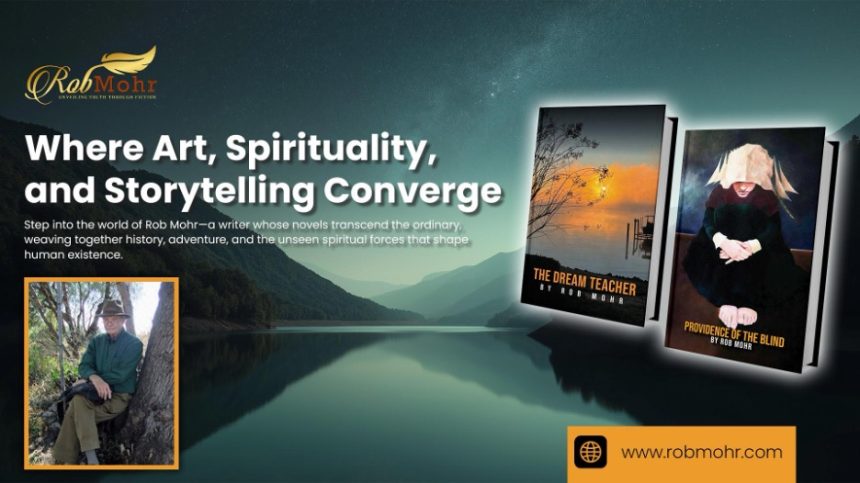
When Rob Mohr speaks, he doesn’t just offer sentences—he offers revelations. His words aren’t simply structured for communication; they’re channeled from years of experience, from distant lands, and from a life lived among stories waiting to be told. In our conversation, what stood out wasn’t just the depth of his narratives, but the heartbeat behind them. That heartbeat connects powerfully in both of his novels, The Dream Teacher and Providence of the Blind. Rob began his writing journey not with the intention of simply becoming an author, but with a mission to express something larger than himself. A former painter in Manhattan and a lifelong educator in Latin America, his experience spans the tangible and the intangible, the political and the poetic. With more than 20 years spent living and working across Bolivia, Ecuador, Peru, Uruguay, and Paraguay, his life is strongly interwoven with the landscapes and communities that now pulse through his fiction.
His first novel, The Dream Teacher, is not only a story—it’s a spiritual and political odyssey. The main character, Marcus Stewart, is a reflection of Rob’s own path: an American educator working with the Quechua people in Bolivia, caught in the chaos of a rising dictatorship. The book unfolds in a realm where spiritual dreams and revolutionary fervor collide. “The political situation,” Rob told us, “is just the stage—the human story is what matters.” And that’s exactly what The Dream Teacher does. It centers on human relationships, particularly those that challenge systems of oppression. Marcus is not portrayed as a savior, but as a man transformed by the people he serves. “I lived as one of them,” Rob said, referring to his time in Latin America. “I didn’t go in to tell people what to do. I went in to learn, to be part of something greater than myself.”
This ethos bleeds into the book’s construction. Characters like Luis Amaro de León—a Bolivian soldier walking the line between oppressor and redeemer—bring moral ambiguity and spiritual depth to the forefront. These aren’t just fictional creations. As Rob reveals, “Every person in this novel is someone I’ve known intimately, someone I understand deeply.” Even the dreams within the book, layered with prophecy and metaphor, reflect his own belief in the spiritual connectivity that runs beneath human experience. If The Dream Teacher is grounded in the past and present of Latin America, then Providence of the Blind propels readers into a near-future struggle with truth, justice, and the erosion of democratic values. The main character, James Scott, deals with a world where spiritual intuition becomes a form of resistance against systemic decay. The novel opens with a surreal encounter on the streets of Manhattan and spirals into a philosophical exploration of political collapse, spiritual awareness, and hope amidst chaos.
In the interview, Rob described himself as a spiritual writer, a label he embraces not in the religious sense, but as someone attuned to deeper realities that most overlook. “In Latin America, the spiritual side of life is not abstract—it’s real, it’s living,” he said. That belief shapes both of his novels. While The Dream Teacher draws upon indigenous cosmology and transformation, Providence of the Blind stretches into metaphysical realms, contemplating providence not as fate but as conscious awareness. James Scott, the main character in Providence of the Blind, operates in both the physical and spiritual planes. He’s attuned to the energy of people, animals, and events around him—a condition that guides his survival and his activism. Like Marcus, James is not portrayed as a hero but as a vessel through which ideas of justice, resistance, and spiritual awakening flow.
Despite their different settings and time periods, both books share a core message: the battle for a just world begins with awareness—both internal and collective. Rob’s writing doesn’t just describe oppression; it challenges the reader to feel it, to understand the systems that create it, and to imagine alternatives grounded in empathy, equality, and vision. And vision is something Rob Mohr has in abundance. Trained in fine arts and spirituality, he brings a unique sensibility to his prose—one that merges the visceral with the ethereal. He cites Paulo Freire’s Pedagogy of the Oppressed as a foundational influence, and it shows. His books do not teach through instruction—they teach through immersion. They ask readers not to observe, but to participate.
During the interview, when asked what keeps him writing, Rob answered simply:
I spend most of my time writing now. I wake up early and write. It’s not just what I do. It’s who I am.
That quiet dedication, the rhythm of a man rooted in purpose, mirrors the tone of his books—steady, thoughtful, relentless in their pursuit of deeper truths. For Rob Mohr, storytelling is a sacred act—one that brings forth forgotten voices, challenges the forces of greed and injustice, and dares to dream of a better world. Whether you’re drawn to political thrillers with soul, or philosophical fiction that expands your worldview, The Dream Teacher and Providence of the Blind offer journeys that are as enlightening as they are unforgettable. These aren’t just books to read—they’re books to live by.