


Nuclear technology has been making a comeback over the past few decades. As improved reactor designs make the news, enrichment technologies are developing steadily in the background. But now, as nuclear energy gains momentum, demand for fuel is accelerating at unprecedented rates. LIS Technologies might have the solution.
To understand the challenges of producing fuel for new nuclear reactors, one first needs to know a bit about enrichment technology.
Enrichment is the process of treating natural uranium to increase the concentration of the U-235 isotope, which reactors need to run. Natural uranium is less than 1% U-235. Nuclear power plants and older reactors usually run on low-enriched uranium (LEU), which is up to 5% U-235. Newer reactors typically need high-assay low-enriched uranium (HALEU), which is up to 20%.
Historically, it’s taken a tremendous amount of space, time, and energy to enrich natural uranium to usable levels. Enrichment facilities must run uranium through cascades of thousands of centrifuges just to create LEU at scale. And given the proliferation of new nuclear technology, current facilities might not be able to keep up.
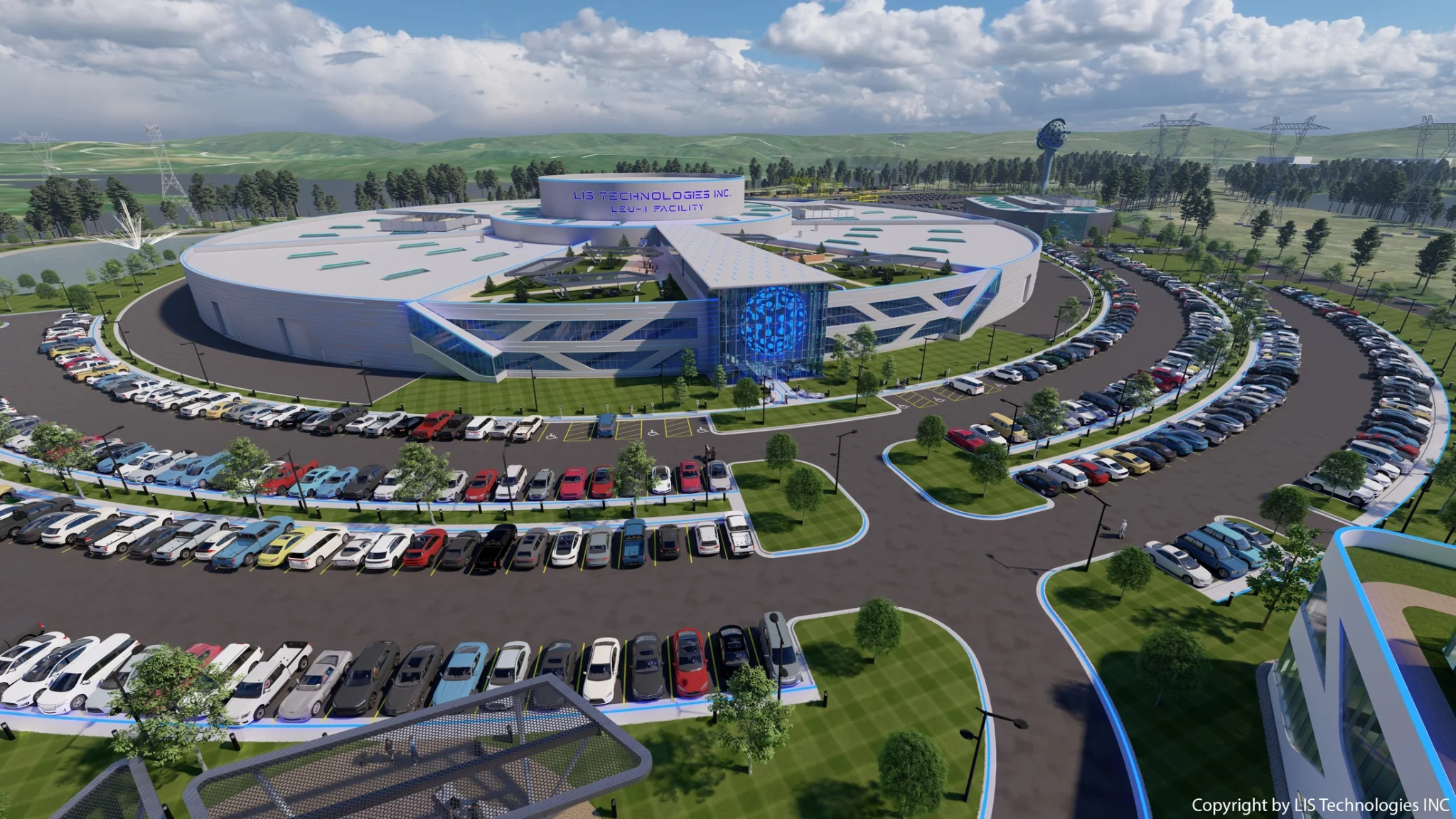
LIS Technologies, an enrichment company based in Oak Ridge, Tennessee, is pioneering a new method that could revolutionize the nuclear sector. The company focuses on laser enrichment, which uses highly specialized lasers to rapidly increase uranium’s concentration of U-235.
“Lasers have always been seen as the holy grail of enrichment technologies because of their economics,” says Christo Liebenberg, one of the company’s cofounders. “The lasers’ wavelength can be selectively tuned to excite only U-235. It’s more elegant, more precise. And it’s much more cost-effective, with a much smaller footprint than your typical centrifuge enrichment.”
The company’s current laser can create the LEU enrichment factor in a single stage, making it far more efficient than any other enrichment technology.
“Single-stage means you irradiate the uranium only once, and it’s enriched all the way from natural to the LEU level,” Liebenberg says. “If you irradiate it a second time, you can go all the way to HALEU, or 20%.”
Laser technology itself isn’t new. But until now, it hasn’t been commercially viable.
“Laser enrichment has been around for 50 years, and no one has been able to successfully scale it, to take it to commercialization,” Liebenberg explains. “Not one out of 26-plus countries. Now we’re using a laser and a process that is very different from what we’ve been using in the past. It’s much more scalable, with significantly higher reliability. We can now scale the entire process.”
One might wonder why a technology with this much promise isn’t already in use across the country. The answer is that it must first clear several hurdles put in place by the Nuclear Regulatory Commission (NRC). LIS Technologies will be required to fully demonstrate the technology and pass numerous safety evaluations before it can commence commercial operations.
“There are a lot of safety-related items that you have to have in place before the NRC will grant you a license,” says Liebenberg. “That’s why it takes so long, like five years or so, because of the integrated safety analysis and environmental reports.”
It may be several years before LIS Technologies’ method is employed on a commercial scale, but it’s already well on its way. And as developers continue to create small, ultra-efficient nuclear reactors, their optimism is clear: The world is moving ever closer to a future powered by clean energy.